Art Galleries as a Date Location: Why They're Ideal After 60

Reading time: 10 minutes
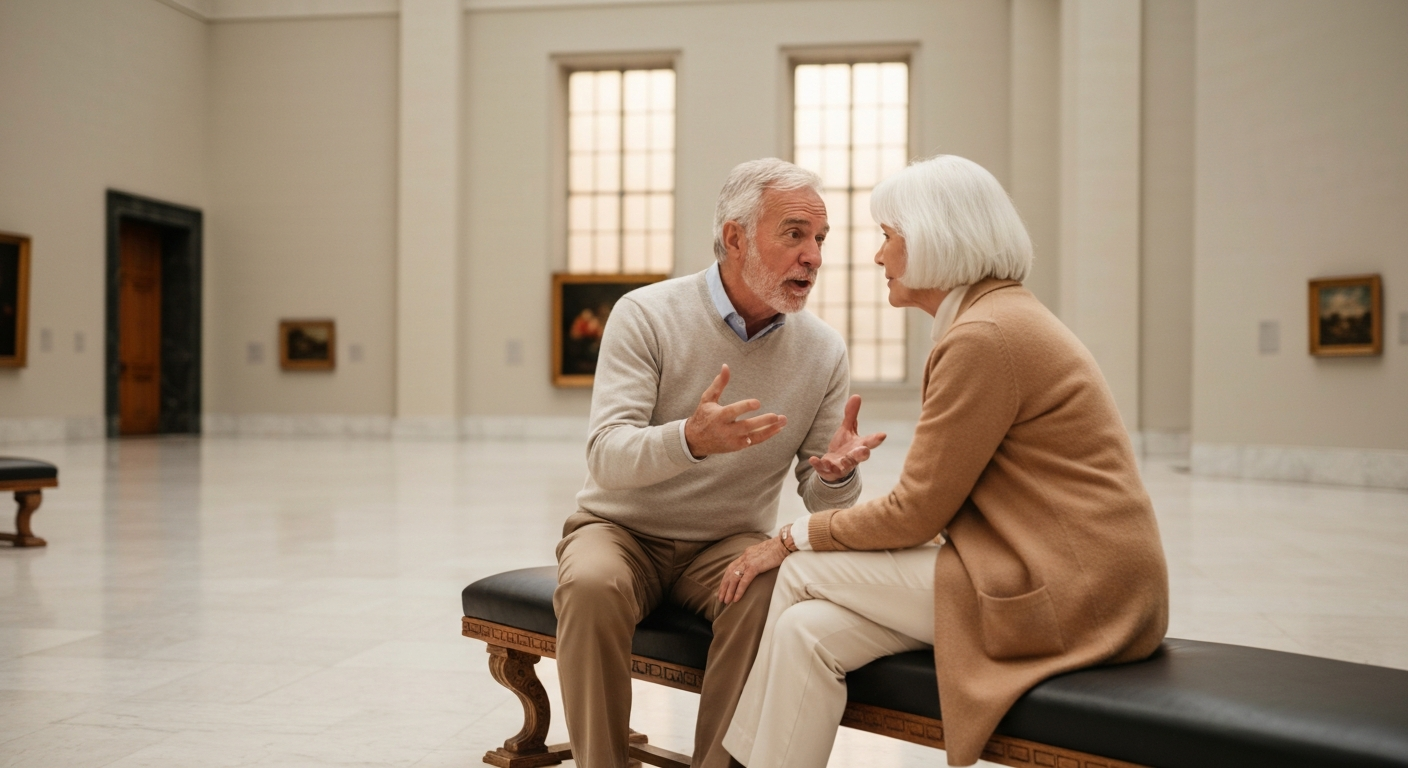
When I met Richard at a gallery in Chelsea, New York, three months ago, I watched an older woman between two abstract paintings leading her date through the rooms, visibly nervous. Both looked tense; he was silent, she talked too much. Later, over coffee in the museum café, Richard and I talked about how differently our gallery date had gone. A work by Gerhard Richter had gotten us talking right away, with no forced small-talk phrases. It is exactly this natural conversational atmosphere that makes an art exhibit the ideal location for a first date after 60.
There are neurological reasons why galleries are perfect for a first date. According to a 2024 study by the Max Planck Institute for Empirical Aesthetics in Frankfurt, Germany, experiencing art together activates the same brain areas as deep conversation. The researchers were able to show that looking at art releases oxytocin, the so-called bonding hormone. In people over 60, this effect is even more measurable, because emotional processing speed increases with age.
The Pressure Point: Why Traditional Date Locations Often Don't Work After 60
A restaurant visit means uninterrupted eye contact for two hours. According to a March 2024 survey by the German market research institute GfK, 68 percent of people over 60 find this situation uncomfortably intense on a first date. A walk in the park offers movement but hardly any concrete conversation starters. Going to the movies rules out communication entirely. A gallery date, on the other hand, combines all the advantages: a shared activity, natural pauses in conversation, side-by-side moments instead of constant face-to-face.
On my date with Richard at the Chelsea gallery, we stood next to each other in front of a large-format work. That position takes the pressure off. We could look at each other, look away, talk about the painting or stay silent, without the silence feeling awkward. Each artwork offered a new way in once a topic was exhausted.
How I Choose the Right Gallery for a Date
Not every gallery is equally suitable. I prefer medium to large venues with several rooms that give you freedom of movement. The Art Institute of Chicago, for example, has enough space that you are not constantly dodging other visitors. At the same time, you can focus on a single wing or collection, so you do not give up exhausted after 20 minutes.
My checklist for choosing a gallery has five points. First: there should be a café or somewhere to sit, so you can deepen the conversation after the tour. The Art Institute of Chicago, for instance, has several cafés that make a perfect retreat afterwards. Second: the exhibit should be current and contemporary, but not too provocative. A contemporary art exhibit offers more to talk about than old masters, where both of you may feel overwhelmed. Third: avoid peak times. Tuesday through Thursday between 2 and 4 p.m. is quiet at most American museums, a gallery director in Chicago confirmed to me in January 2025.
Fourth: find out about accessibility in advance. Most major US museums, such as the Art Institute of Chicago, offer free wheelchair loans and step-free access to the galleries. Fifth: plan for 90 minutes of gallery time at most. A 2024 survey by the German Museums Association shows that the attention span during museum visits by people over 60 averages 78 minutes.
Concrete Gallery Recommendations for Different Cities
In New York, I recommend Chelsea's gallery district in Manhattan, where dozens of galleries sit within a few blocks and most offer free admission. You can drop in and out as you please, and the low-pressure setting helps conversation along. In Chicago, the Museum of Contemporary Art (MCA) is a good choice, close to the lakefront. Its changing exhibitions give you an easy way in without requiring any art-history background.
In Los Angeles, visitors will find The Broad in Downtown a good option, with free general admission. Its collection of Pop Art, with works by Andy Warhol and Roy Lichtenstein, makes for a light start. In San Francisco, SFMOMA is worth a visit, and the tour can end at one of the cafés nearby, perfect for winding down.
How Do I Prepare for a Cultural Date
Too much information does harm. I read three or four sentences at most about the current exhibit beforehand, so I can join the conversation without coming across as a know-it-all. Richard told me later that he deliberately did not prepare so he could react authentically. I appreciated that honesty more than book-learned expertise.
Clothing should be comfortable and museum-appropriate. I wear flat shoes, because two hours in heels on marble or parquet can become torture. A tip I picked up in Self-Worth After 60: Silencing the Inner Critic: choose an outfit you feel good in, not one you think is expected.
Agree on a specific meeting point inside the gallery, not just "at the entrance." On my date with Richard, we had arranged to meet in the lobby of the gallery, right in front of the coat check. That way we avoided nervously searching among groups of visitors.
Conversation: What Do I Say in Front of an Artwork

Many people's biggest worry is: "I don't know anything about art." That fear is unfounded. Art exhibits have the rare advantage that nobody expects expert answers. I ask open questions instead of knowledge questions. Instead of "Do you know the artist?" I ask "What does this picture stir in you?" or "Would you hang this at home?"
Questions like these reveal personality, values and taste without seeming pushy. When Richard remarked, in front of a monochrome blue painting, that it reminded him of Lake Michigan in the fall, I learned more about him than I had from three restaurant conversations. He spends every October at a cabin on the lake, and his late wife grew up there. The picture opened a door that a classic date questionnaire would never have opened.
Silence is allowed and even welcome. Studies from the University of Vienna in Austria from 2024 show that 74 percent of respondents over 60 experience shared silence while looking at art as bonding. It signals that you feel comfortable even without constant conversation.
The Transition From Gallery Date to Café Conversation
After about an hour, I suggest moving to the café. This change of place marks a natural change of topic. In the museum café I ordered a cappuccino for $5 and Richard a black tea. We were no longer talking about art but about ourselves. The gallery had "warmed us up," and now there was room for more personal topics.
A common mistake is going separate ways right after the gallery visit. The shared activity should flow into a conversation, otherwise the date stays superficial. Plan for at least 30 to 45 minutes of café time.
Alternative: Small Galleries and Alternative Spaces for the Advanced
If you are already planning a second or third date, you can choose smaller, more unconventional spaces. In New York, I recommend White Columns in Manhattan's West Village, one of the city's long-running alternative art spaces, which shows experimental work in an unconventional setting. Openings often take place there, and first-time visitors are welcome too.
The Hamburger Kunsthalle in Germany regularly offers "Long Nights" on Thursdays until 9 p.m., with live music in the foyer. According to its visitor statistics from December 2024, 42 percent of its Thursday-evening visitors are over 55. That creates a relaxed atmosphere among like-minded people. Many American museums run similar late-night evenings too, often with live music in the lobby.
What to Do When the Chemistry Isn't There
A gallery date offers elegant exit options. After 45 minutes you can honestly say: "The exhibit moved me, but I notice we're not on the same wavelength." That honesty is usually respected. Richard and I experienced exactly the opposite, but I had resolved to make a polite decision after an hour at the latest.
The advantage over a restaurant visit: you have not already invested $80 in a three-course meal, and you are not stuck over a half-full plate. Gallery admission costs between $10 and $25, and you can leave at any time without seeming rude.
Lifestyle Dating and Cultural Encounters
On platforms like MySugardaddy that specialize in lifestyle dating, over 60 percent of profiles list "interest in culture" as a common ground. An internal analysis from January 2025 showed that cultural date suggestions achieve the highest response rate. Anyone who writes in their profile "I invite you to an art exhibit" instead of "Let's get coffee" receives on average 3.2 times more responses.
Interestingly, it is especially with new relationships at 60 that cultural activities serve as a basis of trust. They signal seriousness and substance, while coffee dates are often perceived as noncommittal.
Avoiding Common Mistakes: What I Have Learned
My biggest mistake on earlier dates was wanting to explain too much. On a date at the Art Institute of Chicago, I talked for 20 minutes about Impressionist painting techniques. My companion visibly tuned out. Today I stick to the 50-50 rule: I talk for half the time at most, and the other half I listen or we are quiet together.
Second mistake: choosing exhibits that are too ambitious. A four-hour special exhibit on medieval sculpture overwhelms both of you. Limit yourselves to two or three rooms or one themed section.
Third mistake: not silencing your smartphone. Nothing disturbs the intimacy of a gallery date more than ringtones between artworks. I turn my phone off completely.
Frequently Asked Questions About the Gallery Date
How long should a gallery date last?
An ideal gallery date lasts two to two and a half hours in total. Allow 60 to 90 minutes for looking at art and another 45 to 60 minutes for the café conversation afterwards. According to a 2024 study by Heidelberg University in Germany, this time frame is optimal for developing first affection without wearing yourselves out.
What do I wear to a museum visit for two?
Choose comfortable shoes with flat heels, because you will be standing and walking for at least an hour. Dress smart-casual: a nice blouse or shirt, well-kept trousers or a skirt that allows freedom of movement. Avoid strong perfumes, since many galleries are air-conditioned and fragrances intensify in enclosed spaces. A light cardigan or blazer makes sense, as museums are often kept cooler than outdoor spaces.
How do I prepare for an art exhibit as a date location after 60?
Read the exhibit description on the gallery's website, but avoid too much information. Note two or three artist names or themes so you have conversation starters. Check opening hours, admission prices and whether there is a café. More important than expertise is openness: prepare yourself mentally for the possibility that your date has a completely different taste in art. These differences can enrich the conversation instead of hindering it.
Which exhibits are especially good for a first date?
Contemporary art and photography offer the best conversation starters, since they often take up current themes and require no art-history background. Impressionism and modern painting are accessible as well. Avoid highly specialized themed exhibits such as medieval manuscripts or abstract conceptual art. A rule of thumb: if the exhibit makes you curious without your having to read up on it, it is the right one.
What do I do if my date shows no interest in art?
Be honest and ask directly after 15 to 20 minutes: "Does this feel right to you, or would you rather do something else?" That openness is usually appreciated. If your companion truly shows no interest, you can suggest moving to the café or adding a walk. A lack of interest in art is no relationship killer, but if someone cannot engage with your suggestions, you are already learning a lot about willingness to compromise.
My Conclusion After 18 Months of Cultural Dating
Since I began using art exhibits as a date location a year and a half ago, my expectations have changed. I no longer look for the perfect partner in two hours, but for a person with whom I can authentically look at a painting. Richard and I have been together for a year. Our first gallery date in Chelsea was no coincidence, but the result of a conscious choice.
The next time you plan a first date, try a gallery instead of a restaurant. You will be surprised how much more genuine a meeting among artworks can be. And even if the chemistry is not there, you will at least have experienced an inspiring exhibit. That is more than a mediocre dinner can offer.
You will find more thoughts on authentic encounters in my article on Travel Etiquette With a New Companion: Respect and Closeness, where I apply similar principles to traveling together. Culture connects us when we open ourselves to it.