Silencing Your Inner Critic: Self-Worth Over 60
Reading time: 12 minutes
On that Tuesday morning in October 2023, I stood in front of the mirror in the bedroom of my pre-war apartment in Chicago and heard it again, that familiar voice: “At 62, with these wrinkles? Forget it.” My inner critic had come back loud and clear after I signed up for MySugardaddy. What I learned over the following eight months changed not only my self-worth over 60, but my whole outlook on life.
The inner critic is not imagination. A 2023 study by the University of Zurich showed that 73 percent of women over 60 regularly engage in negative self-talk, with looks and attractiveness being the most common targets of criticism. These numbers reflect what many of us experience every day but rarely talk about openly.
The turning point: when I first questioned my inner voice
In November, my friend Sandra invited me to a lifestyle dating event at a wine bar in the West Loop. While I was getting ready, my inner critic rattled off the usual list: too old, too soft, too wrinkled, too invisible. But then something unexpected happened. Sandra, who is 65 herself and has been in a wonderful relationship for a year, asked me point-blank: “Would you talk to me like that?” I was startled. Of course not.
That moment was the beginning of my mindset shift. I stopped accepting the voice in my head as absolute truth and began to recognize it for what it was: an outdated habit from decades of social conditioning. According to a 2024 survey by the German Federal Ministry for Family Affairs, Senior Citizens, Women and Youth, 68 percent of women over 60 surveyed said their self-image is shaped more by internalized social expectations than by their own perception.
How do I become more confident in later life: my three-step strategy
After that evening, I developed a method that helped me stop negative thoughts about myself. I call it the “real-time reality check,” and it consists of three concrete steps that I use every day.
Step 1: Write down the criticism and date it
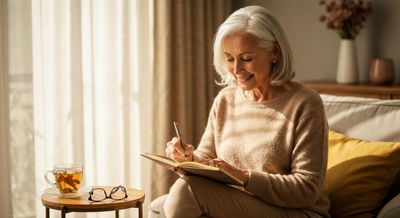
I bought myself a small notebook that I found at a stationery shop in my neighborhood. Every time the inner critic got loud, I wrote the thought down word for word, along with the date and time. Within two weeks I recognized a pattern: 80 percent of the negative thoughts repeated in almost identical form. This realization alone took away some of their power.
Step 2: Collect the counter-evidence
For every critical thought, I noted at least one concrete piece of counter-evidence from my life. “Too old for dating?” Counter-evidence: Maria, 67, had met three interested men last month at a dance night at a community arts center. “Not attractive anymore?” Counter-evidence: the charming architect at the gallery opening I attended had invited me for coffee.
Step 3: Take your friend's perspective
I imagined my best friend telling me exactly what I was just thinking about myself. What would I say to her? This shift in perspective helped me enormously to treat myself with more compassion. According to a 2023 long-term study by Ludwig Maximilian University of Munich in Germany, self-compassion is one of the strongest predictors of psychological well-being in later life.
Feeling attractive again at 60: what really helped
In January 2024, I began working deliberately on my confidence in later life. I signed up for a dance class at a local dance studio, not to lose weight or look younger, but to rediscover the joy of movement. Every Wednesday evening at 7 p.m. I met women and men between 55 and 72 there, who all had one thing in common: they wanted to feel alive.
What surprised me was the direct connection between physical activity and self-esteem. After six weeks I noticed that I was walking more upright, smiling more often and feeling more comfortable in my body. It wasn't about conforming to a beauty ideal, but about experiencing my body as an ally, not an enemy.
At the same time, I invested in professional support. At a style consultation at a department store downtown, I learned which colors and cuts highlighted my personal strengths. The consultant, who was in her mid-50s herself, said a sentence that stuck with me: “Style has nothing to do with age, but with self-knowledge.” That experience also helped me later with travel etiquette with a new companion, where authentic presence matters too.
The inner voice that criticizes me: where it comes from and how I redirect it
At a workshop on “boosting self-esteem in the second half of life” at a community education center in March 2024, I learned that our inner critic is often the internalized voice of caregivers from our childhood and youth. For me it was a mixture of my perfectionist mother and the social messages of the 1970s and '80s, which portrayed women over 50 as invisible.
The psychologist Dr. Susan Weber, who led the workshop, gave us an effective exercise: every time the critical voice shows up, we should interrupt it kindly and say: “Thanks for your opinion, but I'm deciding for myself now.” This simple technique gave me back a sense of control. I wasn't a victim of my thoughts, but could actively choose which ones I gave room to.
A 2024 survey by the German Centre of Gerontology shows that women who actively work on their self-worth report 42 percent higher life satisfaction than those who don't question their negative thought patterns. That number motivated me to keep going, even when it was sometimes exhausting.
MySugardaddy and self-worth: a surprising connection
When I signed up for MySugardaddy in October 2023, I did so with mixed feelings. The inner critic whispered: “Lifestyle dating? At your age?” But the platform became an unexpected practice ground for my new self-worth over 60. Here I could try presenting myself the way I felt, not the way I thought I had to be.
I deliberately wrote my profile authentically: I mentioned my love of the opera at the Lyric, my passion for hiking in the Indiana Dunes and my dry sense of humor. I posted a recent photo from a friend's summer barbecue in which I was laughing heartily, instead of a retouched studio shot. The response surprised me. Within three weeks I received 23 messages from interested men, five of which led to real, in-depth conversations.
What I learned from this: self-worth attracts. People sense when someone is at peace with themselves. This experience also held true in new relationships at 60, where authenticity is the key.
Practical tools for everyday life
Over the months I developed a collection of strategies that helped me tame my inner critic and strengthen my self-worth. I still use these tools every day.
- Morning ritual with positive affirmations: every morning at 7 a.m., before breakfast, I tell myself three things I'm grateful for about myself. For example: “I appreciate my ability to listen,” “I'm proud of my courage to try new things,” “I like my eyes and how they light up when I laugh.”
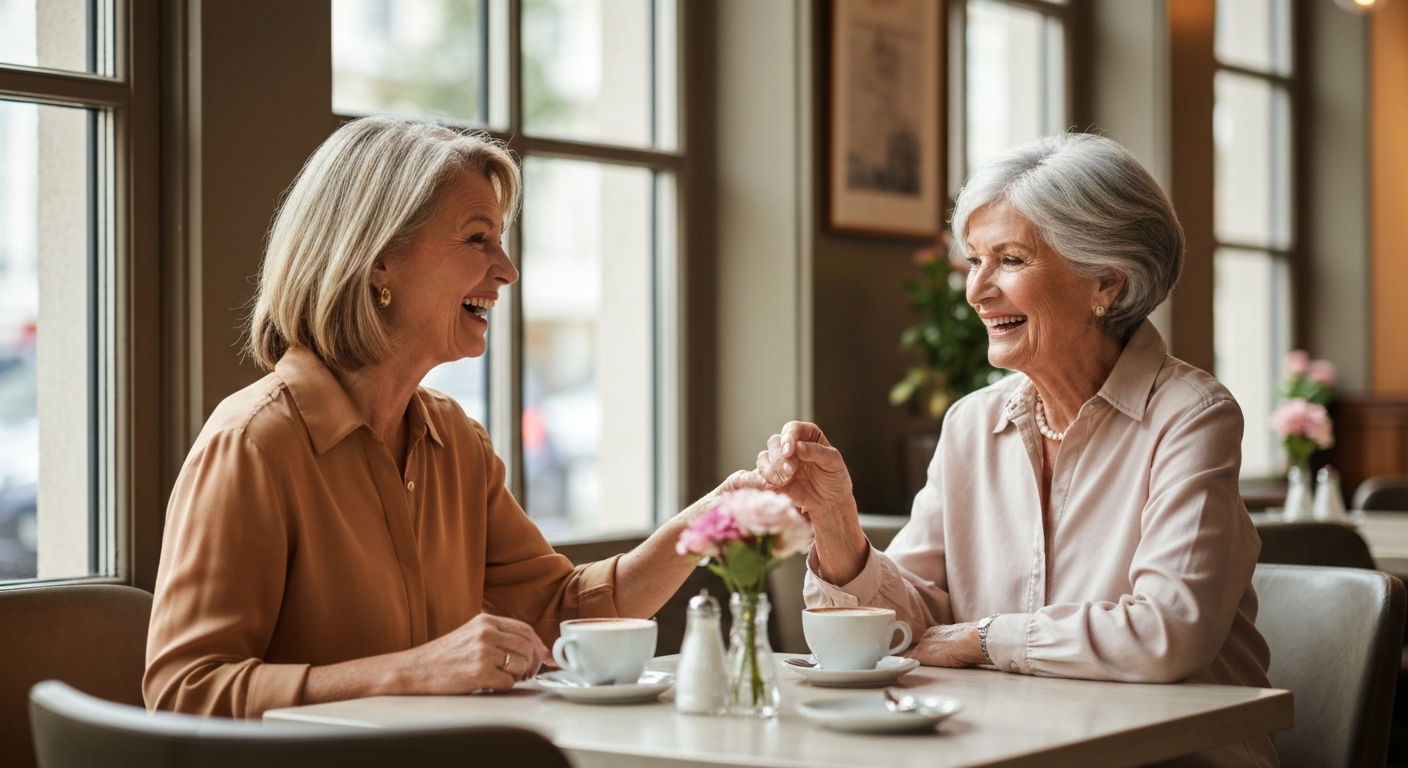
- Weekly self-care date: every Saturday morning I consciously set aside two hours for something that brings me joy. That might be a visit to my favorite café, a loop through Lincoln Park or a long bath with a good audiobook.
- Compliment journal: I write down every sincere compliment I receive in a separate notebook. On days when the inner critic is especially loud, I read through it and remember how others see me.
- Movement as a self-worth booster: at least three times a week I go for a 30-minute walk or dance. The endorphins help not only my mood but also my self-perception.
- Nurturing social connections: I meet regularly with friends who support and encourage me. I have deliberately removed negative people who constantly criticize from my inner circle.
Setbacks are part of it: my honest assessment
It would be dishonest to claim that my inner critic has disappeared completely. She still speaks up, especially before important social events or when I'm tired or stressed. The difference is: I no longer automatically agree with her. Some days I manage that better, others less well.
In April 2024 I had a date with a man I had met through MySugardaddy. He suggested an elegant Italian restaurant in River North. Hours before the meeting, the critical thoughts piled up: too old, not interesting enough, what on earth should I wear. I reached for my notebook, applied my strategies and went despite the nervousness. The date was wonderful, we spent three hours in conversation, and he wrote to me that same evening to say how much he had enjoyed it.
This experience taught me: self-doubt is allowed to be there, it just doesn't have to keep me from acting. Courage doesn't mean the absence of fear, but acting despite the fear.
Boosting self-esteem in the second half of life: what the research says

Scientific research confirms much of what I experienced personally. A 2023 longitudinal study by the Max Planck Institute for Human Development in Germany examined how self-esteem develops across the lifespan. The surprising result: self-worth can still rise in later life when people actively work on their self-perception and stay socially connected.
According to the study, three factors are especially effective: regular physical activity, learning new skills and nurturing supportive social relationships. These were exactly the three elements I had integrated into my life, without knowing the scientific evidence.
The German Federal Institute for Population Research also published a study in 2024 showing that women over 60 who actively engage with the topic of self-worth show markedly higher resilience to age-related challenges. They experience fewer depressive symptoms and report higher overall life satisfaction.
How to feel attractive again at 60: my most important insights
After almost a year of intensive work on my self-worth over 60, I can share some key insights. Attractiveness in later life has little to do with smooth skin or a perfect body. It arises from a combination of self-acceptance, joy in life and the willingness to be authentic.
I've learned that the wrinkles around my eyes are laugh lines, signs of a life lived full of joy. I now wear the gray strands in my hair with pride instead of covering them up at the salon every three weeks. My body isn't perfect by society's standards, but it is strong, healthy and capable of pleasure and movement.
One of the most valuable lessons was realizing that I don't have to be attractive to everyone. It's perfectly enough to be attractive to myself and to the people who suit me. This attitude takes enormous pressure off. Many people have similar experiences when dating in mature years, where authenticity matters more than perfection.
Frequently asked questions about self-worth over 60
How can I stop negative thoughts about myself?
The first step is to consciously notice the negative thoughts and write them down. Once you see them in black and white, they often lose their power. Then question each thought: is this a fact or an opinion? What counter-evidence is there? Would you talk to a friend this way? This cognitive reframing technique helps interrupt automatic negative thought patterns and replace them with more realistic, kinder ones.
Why is it harder to feel attractive over 60?
We live in a society that overvalues youth and often equates age with loss. For decades we have internalized messages suggesting that attractiveness is tied to a certain age. On top of that, many of us experienced physical changes during menopause that influenced our self-image. The good news: these imprints can be actively changed once we realize that attractiveness is multifaceted and has to do with presence, confidence and authenticity.
How long does it take to really improve self-worth in later life?
You may notice first changes after just a few weeks of consistent practice. In my case, I felt a clear shift after about six weeks of daily work with my notebook and the affirmations. The inner critic got quieter, and I doubted myself less. Building stable, robust self-worth, however, is a process of several months. After about eight months I felt fundamentally different, more self-assured and more at peace within myself. What's important: it is not a linear process, there are good days and harder ones.
Can lifestyle dating really help with self-worth?
Yes, if you use it as a practice ground for authenticity. Platforms like MySugardaddy offer the chance to present yourself as you are and to receive positive feedback. Writing an honest profile is already an exercise in self-reflection and self-acceptance. The response you receive shows you that people value you as you are. What matters is that you don't define yourself by the number of messages, but by the quality of the connections that develop.
What do I do when the inner critic gets very loud on bad days?
On days like these you need an especially large helping of self-compassion. I've gotten into the habit of telling myself: “Today is a difficult day, and that's okay.” Then I reach for my compliment journal, call a good friend or deliberately treat myself to something good like a walk or a hot bath. Sometimes it also helps to address the critic directly: “I hear you, but today I have no energy for you. We'll talk tomorrow.” Give yourself permission not to have to be strong every day.
My conclusion: self-worth is a decision
Today, almost a year after I began actively questioning my inner critic, I can say: my self-worth over 60 is more stable and more genuine than ever before in my life. I've learned that self-worth is not a question of age, looks or circumstances, but a daily decision. The decision to meet myself with respect and kindness, even when I'm not perfect.
The inner critic is still there, but she has lost her tyrannical character. She has become a quiet voice that I can acknowledge but don't have to take seriously. Instead I more often hear a different voice, a friendly, encouraging one that says: “You can do this. You are enough. You are valuable, just as you are.”
If you decide to work on your self-worth, start today. Not tomorrow, not next week. Pick up a notebook, write down three things you appreciate about yourself, and take one small, concrete step toward self-care. You deserve to feel comfortable in your own skin, regardless of what the mirror or society tells you. Your worth lies not in your youth, but in your lived experience, your wisdom and your unique personality.